Category: Article

  • The Graceful Arch of Gratitude: Understanding the Penjor of Bali

    The Graceful Arch of Gratitude: Understanding the Penjor of Bali

    In the Quiet Curve of Bamboo

    On the morning of Galungan, as dawn’s light washes the alleys of Bali in soft gold, I found myself pausing under the arching silhouette of a bamboo pole. The air was fragrant with young coconut leaves, incense smoke curling like whispering prayers, and the distant murmur of temple bells. That bamboo pole was a penjor, and in that gentle curve I saw an entire people’s reverence for nature, for the divine, and for the invisible forces of generosity that sustain their world.

    What Is a Penjor

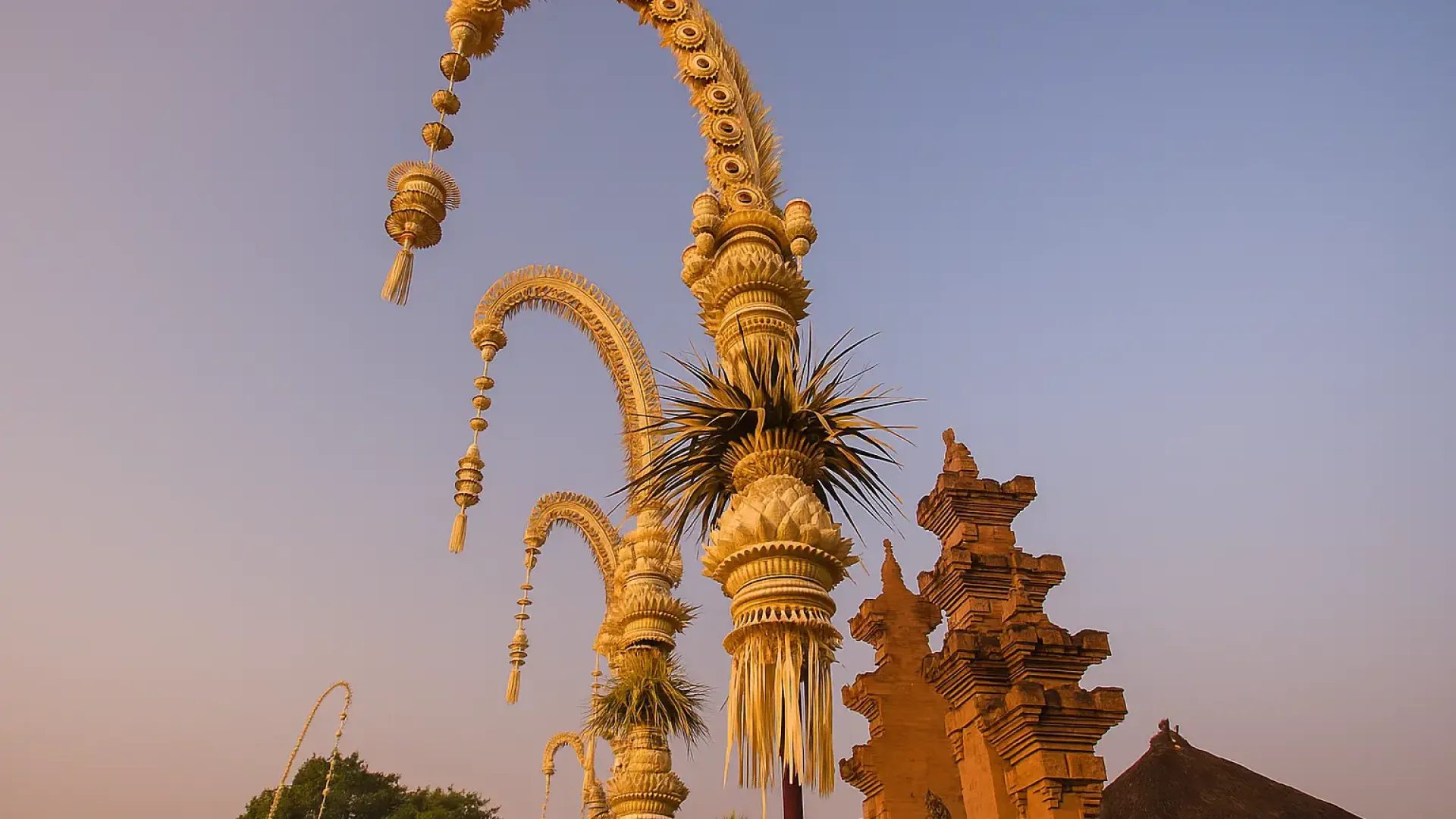
    A penjor is a tall bamboo pole, often rising five to ten metres, curved near the top and richly adorned with young coconut leaves (janur), rice, grains, fruits, flowers, cloths and sometimes snacks or coins (en.wikipedia.org). It is raised in front of Balinese homes and temples during Galungan, the occasion that marks the triumph of dharma (good) over adharma (evil). Every element carries meaning: the tall pole reaching upward, the bend at the top, the harvest offerings, the fabric colours.

    The Symbolic Language of the Penjor

    Each penjor tells a story. The bamboo itself is a nod to the great mountain, often identified with Mount Agung, the mythic domain of the gods. The curved tip signals the flow of energy from the sky into the earth. The young coconut leaves stand for purity and sincerity, while the offerings of rice and fruit speak of gratitude for the harvest and the bounty of nature. At the base, a small shrine (sanggah cucuk) becomes a sacred place for incense and prayer (en.wikipedia.org).

    One writer described the penjor as “a bridge between the mortal realm and the divine,” a visual hymn to interconnectedness.

    The Life of a Penjor: From Craft to Ceremony

    In villages across Bali, the crafting of a penjor becomes a communal event. Families and neighbours gather to select the right bamboo, bend it carefully, weave janur into decorative patterns, attach baskets of offerings, and raise the pole with reverence.

    On the day of Penampahan Galungan, the eve of the festival, these penjors rise across every road and lane. By Galungan morning, the island is already transformed. They stay in place until Kuningan, ten days later, when the spirits of ancestors are believed to return to heaven.

    When to Visit: Timing and Atmosphere

    For 2025, Galungan falls on Wednesday, 19 November, followed by Kuningan on Saturday, 29 November. In the days before Galungan, Bali hums with preparation: bamboo is shaped, leaves are trimmed, and offerings are made. Arrive a day earlier, and you’ll witness more than a celebration; you’ll see a ritual of patience and artistry unfold in every household.

    Where to See the Most Beautiful Penjor: Ubud and Gianyar

    On the day of Galungan, every region in Bali raise penjors, from coastal villages in Karangasem to mountain hamlets in Bangli. The island becomes a living tapestry of devotion, with every family raising its own symbol of gratitude and victory.

    Yet, if you seek the most majestic and artistically refined penjors, Ubud and Gianyar Regency are the places to go. The people here are known for their craftsmanship and deep connection to Balinese aesthetics, producing penjors that blend spiritual significance with exquisite design.

    Ubud

    In the soft light of morning, the streets of Ubud become a gallery of penjors. Along Jalan Raya Ubud, Jalan Hanoman, and Monkey Forest Road, each household showcases its creation, tall, elegant, and ornamented with intricate woven leaves. The wind rustles through the janur, and you feel the quiet grace of faith expressed through art.

    Tegalalang and Pejeng

    In these agrarian villages, penjors follow ancient forms. They are simpler, adorned with natural materials like grains, tubers, and palm leaves, reflecting the farming life that sustains the Balinese spirit. Watching locals light incense beneath them, surrounded by emerald rice fields, is like stepping into a scene unchanged for generations.

    Gianyar Town and Mas Village

    Known for their artisans, these areas produce penjors that are breathtaking in detail: layered bamboo ornaments, finely carved patterns, and handwoven fabrics that shimmer in the tropical light. Many of these craftsmen supply temple decorations across the island.

    A Moment of Reflection: What the Penjor Teaches

    Standing beneath a penjor one early morning, I understood why Balinese people never separate faith from daily life. In that bamboo pole lies an entire philosophy: gratitude, harmony, balance. It reminds us that spirituality does not live only in temples but also in the gestures of ordinary life, in how people decorate, give, and connect.

    In a world often rushing toward novelty, the penjor teaches stillness. It tells us that beauty can be devotion, and that gratitude, expressed simply and sincerely, is the greatest offering of all.

    Practical Tips for Visitors

    If you are in Bali during Galungan, here are some gentle ways to appreciate the festival respectfully:

    • Dress modestly when visiting temples or villages.
    • Ask before entering temple compounds or photographing rituals.
    • Observe quietly and let your attention be part of your offering.
    • Visit early morning or at sunset for the most beautiful light.
    • Remember that every penjor is a prayer, not a decoration.

    Conclusion The Sacred Arch of Everyday Life

    When you walk through Bali during Galungan and see thousands of penjors curving gracefully toward the sky, pause for a moment. Breathe in the scent of incense, listen to the temple bells, and feel the soft wind passing through the leaves.

    Each penjor is a message, a gesture of gratitude, a bridge between heaven and earth, a living expression of balance.

    To witness them is to see Bali not as a destination, but as a heartbeat, steady, sacred, and alive with devotion.

  • Ultimate Bali Travel Guide 2026: Visa, Culture, and Hidden Gems You Must Know Before You Go

    Ultimate Bali Travel Guide 2026: Visa, Culture, and Hidden Gems You Must Know Before You Go

    I. Welcome to the Island of the Gods

    Bali Travel Guide 2026 brings you everything you need to explore the Island of Gods with confidence, from visa updates and local customs to hidden waterfalls, street food, and responsible travel practices.

    Bali, often called the Island of the Gods, remains one of the world’s most beloved destinations in 2026. It is a place where spirituality breathes through daily life, where rice terraces shimmer like green mirrors, and where every offering laid on a doorstep whispers gratitude.

    Whether you’re chasing the sunset at Uluwatu’s cliffs, wandering through the calm of Ubud’s rice terraces, or tasting authentic lawar in a small warung, Bali invites you to slow down. Here, travel is not about ticking off destinations — it’s about feeling the heartbeat of the island.

    II. Visa and Entry Requirements – Bali Travel Guide 2026

    Traveling to Bali is simple, but knowing the visa requirements saves time and trouble at the airport.

    • Visa on Arrival (VoA): Available for citizens of over 90 countries. Valid for 30 days and extendable once.
    • E-VOA (Electronic Visa on Arrival): Apply online before departure through imigrasi.go.id for a smoother airport experience.
    • Visa-Free Entry: Available for ASEAN countries such as Singapore, Malaysia, and Thailand for up to 30 days.

    Tip: Always carry your passport and a copy of your visa, either printed or digital. Random checks can occur, especially in tourist hubs like Canggu or Ubud.

    (Source: Smartraveller.gov.au)

    III. Best Time to Visit Bali – Essential Part of Your Bali Travel Guide 2026

    Bali is a year-round destination, but understanding the seasons helps you plan better.

    • Dry Season (April–October): Best for beach days, surfing, diving, and outdoor exploration.
    • Rainy Season (November–March): Expect short tropical showers, vibrant greenery, and fewer crowds.

    Cultural highlights include:

    • Galungan and Kuningan, when Balinese families celebrate the victory of good over evil.
    • Nyepi, the Day of Silence, when the island pauses — no flights, no traffic, and no noise.

    The best months to visit are May, June, and September, offering ideal weather, smaller crowds, and more affordable hotel rates.

    IV. Balinese Culture and Etiquette

    Culture is the soul of Bali. To experience it fully, travelers are encouraged to respect local customs and traditions:

    • Dress modestly when visiting temples; shoulders and knees should be covered.
    • Remove your shoes before entering sacred areas.
    • Avoid touching someone’s head — it is considered the most sacred part of the body.
    • Use your right hand when giving or receiving something.

    Attending a Melukat (purification ceremony) or observing a temple festival allows visitors to see the island’s deep spiritual rhythm in motion.

    (Source: LoveBali.baliprov.go.id)

    V. Top Things to Do in Bali

    Bali Travel Guide 2026 offers something for every kind of traveler — from spiritual seekers to surfers and storytellers.

    • Ubud: Explore the Sacred Monkey Forest, Tegallalang Rice Terraces, and holistic yoga retreats.
    • Seminyak and Canggu: Discover stylish cafes, beach clubs, and creative digital nomad spaces.
    • Uluwatu: Known for world-class surf, clifftop temples, and dramatic ocean views.
    • Nusa Penida and Nusa Lembongan: Home to iconic beaches like Kelingking and manta ray snorkeling.
    • Hidden Gems: Waterfalls in Munduk, green valleys in Sidemen, and Amed’s volcanic black-sand beaches.

    Tip: Rent a scooter for flexibility, but always wear a helmet and follow local traffic rules.

    VI. Bali Street Food and Local Cuisine

    Balinese cuisine is a journey through spice, ceremony, and community.

    Don’t miss:

    • Lawar: A traditional minced dish of vegetables, coconut, and meat, often prepared during major ceremonies.
    • Babi Guling: Roasted suckling pig seasoned with rich local spices.
    • Nasi Campur Bali: A mixed rice dish that tells a story of balance and flavor.

    For authentic flavors, visit Gianyar Night Market or Sanur Sindhu Market. If you’re short on time, local warungs and convenience stores like Circle K or Indomaret Point also offer tasty, affordable options.

    VII. Getting Around Bali on a Budget – Updated for 2026

    Navigating Bali is simple, but choosing the right mode of transport depends on your style and budget.

    Estimated daily budget:

    • Backpacker: USD 30–50 per day
    • Mid-range traveler: USD 60–120 per day
    • Luxury: USD 200+ per day

    Transport options:

    • Trans Metro Dewata: Bali’s official public bus system, affordable and reliable at IDR 4,400 per trip.
    • Scooter rental: Ranges from IDR 80,000–120,000 per day.
    • Ride-hailing apps: Use Gojek or Grab for short distances.

    Tip: Avoid unregistered taxis at airports. Instead, use the official taxi counter or Grab Lounge for safety and transparency.

    VIII. Where to Stay in Bali

    Every region in Bali offers a different atmosphere and energy:

    • Ubud: Ideal for nature, wellness, and art lovers.
    • Seminyak: Perfect for luxury stays and nightlife.
    • Canggu: A hub for surfers and digital nomads.
    • Nusa Dua: Calm and family-friendly with resort comfort.
    • Uluwatu: Known for romance and ocean-view villas.

    For a meaningful stay, consider eco-lodges, bamboo villas, or riverside homestays — they offer both sustainability and charm.

    IX. Responsible and Sustainable Travel in Bali 2026

    The Love Bali Campaign encourages travelers to explore consciously and give back to the island that welcomes them.

    You can make a difference by:

    • Bringing reusable bottles and avoiding single-use plastic.
    • Staying at eco-certified accommodations.
    • Respecting local ceremonies and temple spaces.
    • Supporting community-based tours and local artisans.

    As the campaign reminds us: Protecting culture and nature means protecting Bali’s soul.

    X. Essential Apps and Practical Travel Tips

    Useful apps for your Bali trip:

    • Gojek and Grab for rides and food delivery
    • Traveloka and Agoda for accommodation
    • Google Maps and MAPS.ME for offline navigation
    • XE Currency for real-time exchange rates
    • Blue Bird Taxi for safe, metered rides

    Tip: Buy a local SIM card (Telkomsel or XL) at the airport. Data plans start from IDR 50,000 and ensure reliable connectivity throughout your trip.

    XI. Final Tips Before You Go

    • Respect road closures during local ceremonies — they are part of the island’s spiritual rhythm.
    • Carry some cash, as not all small shops or warungs accept cards.
    • Keep a copy of your passport for emergencies.
    • Greet locals with a smile — kindness is Bali’s most universal language.

    Bali is more than a destination; it is a living lesson in harmony, gratitude, and presence. Once you have been here, a part of you will always want to return.

  • The Story of Lawar Bali, From Sacred Feast to Everyday Flavor

    The Story of Lawar Bali, From Sacred Feast to Everyday Flavor

    In Bali, food is never just about taste — it’s about offering, celebration, and connection. Among the island’s many traditional dishes, Lawar Bali stands as a symbol of harmony between ritual and daily life, between sacredness and simplicity.

    A Dish Born from Ceremony

    Once upon a time, Lawar was a dish reserved for grand ceremonies — the rhythmic pulse of Bali’s spiritual life. During Galungan, when families return home to honor ancestral spirits, the aroma of freshly ground base genep (a rich Balinese spice paste) would fill the air as men gathered in the family courtyard to prepare lawar.

    Lawar was also present in wedding ceremoniesmelaspas (rituals for new buildings), and other sacred celebrations. It wasn’t an everyday dish — it was a luxury, a feast that required effort, cooperation, and costly ingredients. In the past, meat was not easily available. Pigs and chickens were raised with care, often slaughtered only for significant temple days. The preparation of lawar was as much a spiritual duty as a culinary one.

    The Making of Lawar: A Ritual of Balance

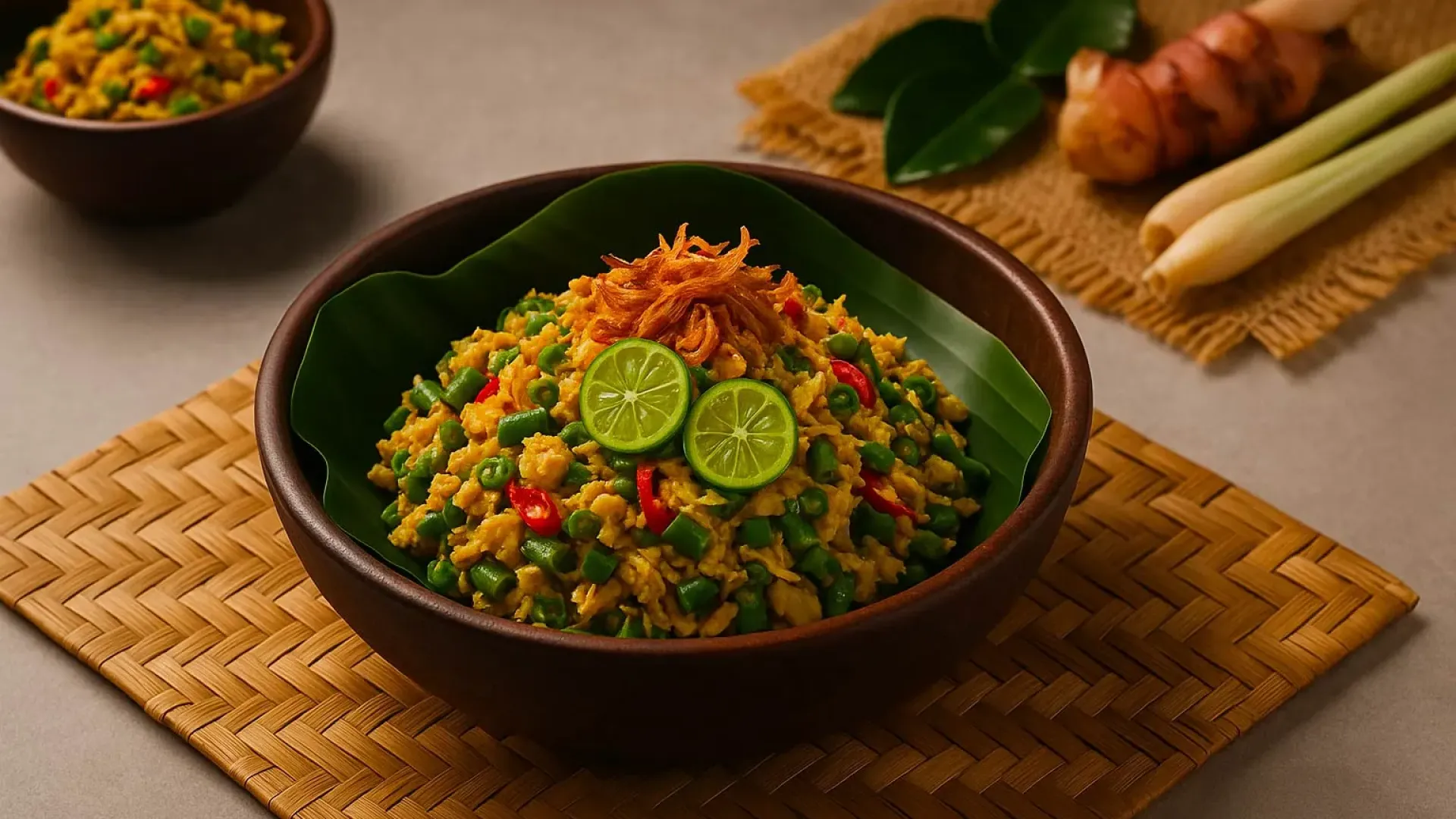
    Every ingredient in Lawar Bali carries meaning. The base genep — a blend of turmeric, galangal, ginger, garlic, shallots, chilies, and shrimp paste — forms the soul of the dish. Freshly grated coconut brings texture and sweetness, while chopped meat adds substance.

    Traditionally, there are two main types:

    • Lawar Putih (White Lawar) – pure and fragrant, made without blood, symbolizing balance and clarity.
    • Lawar Merah or Lawar Bara (Red Lawar) – vibrant and earthy, colored by freshly mixed animal blood, representing life force and strength.

    The act of mixing the ingredients — often by hand — was a communal experience. Villagers would chat, laugh, and share stories while preparing lawar. It was not merely cooking; it was a reaffirmation of kinship and cultural identity.

    From Ceremonial to Common Table

    Today, Lawar Bali has journeyed beyond temple courtyards. You can find it in roadside warung, bustling markets, and even modern Balinese restaurants. What was once sacred is now everyday — yet it still retains the essence of ritual and respect.

    The variations have also evolved. While pork and chicken remain traditional, modern tastes have brought new versions: beef lawargoat lawar, even octopus lawar (lawar gurita) found near coastal villages. Each reinterpretation keeps the spirit alive — local ingredients, local hands, and the same devotion to flavor and balance.

    Lawar Bali in Modern Cuisine

    In recent years, Lawar Bali has stepped into the spotlight of contemporary Balinese and Indonesian gastronomy. From fine dining restaurants in Ubud to fusion cafés in Canggu, chefs are reinventing lawar with creative presentations — pairing it with rice crisps, plating it as an appetizer, or even turning it into a vegan version using young jackfruit or tempeh.

    Yet, beneath the modern garnish, the essence remains: Lawar Bali continues to tell the story of tradition meeting innovation — where sacred recipes adapt, but never lose their soul. This evolution not only preserves cultural heritage but also celebrates the resilience of Balinese cuisine in a changing culinary world.

    Reflections: The Taste of Togetherness

    Eating Lawar Bali today is more than enjoying a local delicacy; it’s tasting a piece of Bali’s living heritage. Each bite carries the island’s story — of community, spirituality, and adaptation.

    In its transformation from sacred feast to everyday meal, lawar mirrors the Balinese way of life: embracing change while preserving the soul of tradition. Whether shared at a temple ceremony or a humble roadside stall, Lawar Bali remains what it has always been — a celebration of life itself.

  • Bali’s Gateway Revealed: Architecture, History & Travel at I Gusti Ngurah Rai Airport

    Bali’s Gateway Revealed: Architecture, History & Travel at I Gusti Ngurah Rai Airport

    Stepping into I Gusti Ngurah Rai International Airport (DPS) is more than the start of a holiday in Bali: it is an opening chapter to an island steeped in culture, design, and mobility. Here you’ll find an airport that blends modern efficiency with Balinese architectural identity, serves as the main international gateway to the island, and is linked by well-established transport options that set the tone for your journey ahead.

    The Architecture: Where Tradition Meets Terminal

    From the moment you arrive at Ngurah Rai International Airport, you are greeted by architectural cues that blend tradition and modernity. The exterior features pillars sculpted in the shape of a bale kul-kul and gateways reminiscent of the Balinese “candi bentar”. bali-airport.com+3sg.news.yahoo.com+3Kija Travel+3

    Inside, warm tones of sandstone and wood complement sleek glass and steel, a design that achieves both comfort and cultural authenticity. The roofs echo layered temple profiles; the colonnades reflect local motifs. ofa.upd.edu.ph+1

    Terminal layouts serve high-volume traffic while offering a sense of ambience, spacious arrival halls, separate departure zones, sufficient boarding gates, and lounges. The modernisation includes a new international terminal opened circa 2013–14, designed to handle up to 25 million passengers annually. Wikipedia+1

    Architecture isn’t a superficial addition here — it conveys the message: this is Bali, before you even step outside.

    A Short History & Rise of International Flights

    The story begins in 1931, when the Dutch colonial government established a simple grass airstrip in the village of Tuban along Bali’s southern coast. balicheapesttours.com+2Infinite Flight Community+2

    In the 1960s, as jet travel expanded, the runway was extended (including land reclamation into the sea) and new terminal facilities were constructed. On 1 August 1968 (some sources cite 1969), the expanded airport was officially inaugurated as Ngurah Rai International. Gusti Bali Tours+2Wikipedia+2

    It is named in honour of I Gusti Ngurah Rai, a Balinese hero who died in 1946 fighting for Indonesia’s independence. indonesiaairport.com+1

    By the 2010s, the airport had become the second-busiest in Indonesia (after Jakarta’s Soekarno-Hatta) and was important for international connectivity: by 2018, around 23.7 million passengers passed through. Wikipedia+1

    Today, major carriers from Asia and Australia fly to Bali, and the airport is equipped to handle wide-body aircraft, including the Airbus A380. Wikipedia

    Distances & Travel Time to Key Destinations

    From the airport’s location in Tuban (between Kuta and Jimbaran), you are already close to some of Bali’s most-visited areas. Bali International Airport (DPS)

    • To Kuta: very short (just a few minutes’ drive)
    • To Seminyak: about 20-30 minutes, depending on traffic, theprivateworld.com
    • To Ubud: around 38 km, roughly 1 hour by car in good traffic. theprivateworld.com+1
    • To other parts of the island, you’ll find standard taxi/fixed-rate journeys extending accordingly.

    The airport’s close proximity to resort hubs means that arriving travellers can transition quickly from plane to beach, or to cultural sites, depending on their schedule.

    Taxi, Ride-Hailing & Transport Services

    Official airport taxi counter and fixed rates

    Once you exit the arrivals hall, you’ll find the official taxi counter where you choose your destination and pay a set rate. These taxis are pre-set by destination rather than metered.

    Ride-hailing / App services at the airport

    For those comfortable with apps, you’ll find designated pick-up zones and lounges for services such as Grab and Gojek in the international & domestic arrival terminals. bali-airport.com+1

    Helpful advice & caveats

    • As a tip, at authorised counters tends to be more transparent.
    • Pre-booking transfers (especially for early/late flights) can take away uncertainty and ensure a fixed-fee arrangement. Klook Travel+1

    Why This Matters: Reflections & Travel Consciousness

    Arriving at Ngurah Rai is more than a logistical waypoint — it is a transition into the cultural and environmental context of Bali. The architecture reminds you of place and identity; the transport services reflect local hospitality, and the proximity to destinations gives you immediate access to both relaxation and discovery.

    But with that access comes responsibility. As a traveller, choosing authorised transport options supports an organised system and helps curb informal surcharges. Respecting the local architecture, the environmental setting (especially in high-tourist zones), and the culture you are about to immerse yourself in makes the difference between being just a guest and being a thoughtful visitor.

    Conclusion

    From a modest Dutch-era grass strip to a major international gateway infused with Balinese design, I Gusti Ngurah Rai International Airport remains a compelling first act of your Bali story. Whether you note the carved gateways in the terminal, the ease of an app-ride to your resort, or simply the relief of stepping into warm island air, the journey begins here — with comfort, context, and culture in tow.

  • Galungan 2025: Bali’s November Homecoming

    Dawn in a Balinese village during Galungan smells of incense, steamed rice, and wet banana leaves. In November 2025, with Galungan on Wednesday, 19 November, and Kuningan on Saturday, 29 November, that scent threads through alleys and roads, calling ancestors home and inviting the living to remember.

    The story the island tells

    Galungan marks the triumph of dharma (good) over adharma (evil) and the homecoming of ancestral spirits. It is both a cosmic and intimate family affair: bamboo penjor arch over streets, canang sari at doorways, and family altars shimmer with color. The festival follows the 210-day pawukon calendar, meaning Bali observes this rhythm twice yearly. In November 2025, the island will fold inward for reflection and outward in ceremony.

    The days that lead to homecoming

    Galungan does not arrive suddenly; it is prepared for, day by day.

    Three days before (Penyekeban), houses quieten as bananas are ripened for offerings. Two days before (Penyajahan), kitchens hum with jaja sweet rice cakes and colorful treats, folded into palm-leaf trays. The day before (Penampahan) is the busiest and most visceral: families prepare lawar and other ceremonial dishes, sometimes including ritual slaughter, symbolically sweeping away the animalistic impulses of the self. On Galungan morning, families dress in their finest lace kebaya for women, sarongs, and udengs for men and gather at home shrines and village temples for prayer, offerings, and the simple, powerful act of hospitality toward the unseen.

    Ten days after Galungan, on 29 November 2025, Kuningan marks the gentle farewell. Yellow — kuning — softens the island; tamiang and kolem are placed as symbols of protection and rest. Ancestors return to the spirit world, leaving behind blessings and a renewed sense of moral purpose.

    What you see and feel

    Look down any lane and you will find penjor: tall bamboo poles, festooned with young coconut leaves, rice, and small gifts, their tips heavy with offerings. Women walk with baskets of flowers and rice on their heads; temple gongs thrum and bells answer. Children run between processions and quiet courtyards; some laugh, others hold their breath in the hush of prayer. Food is communal — rice, lawar, and the unmistakable aroma of babi guling in villages where that is customary.

    Galungan is not a single spectacle but a string of private and public moments. It is at once solemn and warm, a moral recommitment wrapped in family noise and ritual precision.

    A visitor’s guide to being respectfully present

    If you will be in Bali for Galungan in November 2025, treat the days as an invitation to observe, not perform.

    • Dress modestly: cover shoulders and knees; carry a sarong and sash if you plan to enter temples.
    • Give space during prayers and processions; do not step over offerings.
    • Ask before photographing people in prayer. Many Balinese prefer a quiet presence rather than being the subject of a snapshot.
    • Be prepared for changes: markets may close, and transport can be slower as families travel between homes and temples. Plan flexibly and prioritize local rhythms over strict itineraries.

    What Galungan leaves behind

    Beyond the visual — penjor, canang, yellow rice — Galungan leaves a quieter inheritance: a reminder to align thought and action, to conquer the small violences of selfishness, and to welcome those who came before us with offerings and gratitude. In the November 2025 cycle, the island will fold these lessons into daily life for weeks: a communal patience, a renewed care for home altars, and the soft, steady cadence that comes when a community remembers its roots.

    Walk slowly down a road lined with penjor, breathe in the incense, and you might feel, for a moment, that the world has tilted toward something kinder. That is the quiet triumph Galungan asks us to keep.

  • Bali’s Day of Silence: A Survival Guide for Tourists During Nyepi

    Bali’s Day of Silence: A Survival Guide for Tourists During Nyepi

    If you are visiting Bali in March, there is a high chance your holiday will intersect with Nyepi, Bali’s Day of Silence. For first-time visitors, Nyepi can sound intimidating. No going out, no entertainment, no internet, and even the airport shuts down. Yet every year, many travelers say Nyepi becomes the most memorable day of their Bali trip.

    This Nyepi survival guide for tourists will help you understand what really happens, what is expected of you, and how to turn 24 hours of silence into a rare and meaningful travel experience.

    Understanding Nyepi and the Catur Brata

    Nyepi marks the Balinese New Year according to the Saka calendar. Instead of fireworks and parties, Bali welcomes the new year with total stillness. This day is governed by Catur Brata Penyepian, the four sacred prohibitions observed across the island.

    First, no fire or light. This includes bright lamps and visible flames. Hotels keep lights dim and curtains closed to respect the rule. Second, no work. Offices, shops, and businesses shut down completely. Third, no travel. Streets are empty, airports are closed, and even the beach becomes off-limits. Fourth, no entertainment. No music, no television, and no public activities.

    As a tourist, you are not expected to practice these rules spiritually, but you are required to respect them physically. Staying inside your hotel is not a suggestion. It is mandatory.

    What Actually Happens on Nyepi Day

    At around 6 a.m., Bali goes silent. The international airport closes for 24 hours, making Nyepi the only day of the year when no flights arrive or depart. Roads are blocked by traditional security guards known as pecalang, and they quietly patrol neighborhoods to ensure compliance.

    Mobile data is typically shut down across the island. Wi-Fi inside hotels often still works, but it can be slow or intentionally limited. Television channels may be disabled. Food outlets are closed, except for hotel kitchens serving in-house guests.

    You stay inside your hotel compound. Resorts allow guests to use internal facilities like pools or gardens discreetly, while smaller hotels may ask guests to remain in their rooms.

    This is the heart of the Nyepi survival guide for tourists. Once you understand that nothing is wrong and everything is intentionally quiet, the anxiety disappears.

    Why Nyepi Can Be a Gift for Travelers

    Nyepi offers something increasingly rare in modern travel: enforced stillness. No traffic noise. No motorbikes. No social media scrolling. Even the air feels different.

    One of Nyepi’s greatest rewards comes after sunset. With no streetlights and minimal light pollution, Bali’s sky reveals itself in full clarity. On a clear night, you can see the Milky Way with the naked eye. Stargazing during Nyepi is often described as magical, even by seasoned travelers.

    Many guests discover that Nyepi becomes a personal reset. Reading without distraction, long conversations, journaling, or simply sleeping deeply feels indulgent in a way beach clubs never do.

    What to Pack Before Nyepi

    Preparation is the difference between boredom and bliss. Use this Nyepi survival guide for tourists as your checklist.

    Bring snacks and drinks. Hotels provide meals, but having your favorite chips, chocolate, or instant noodles helps. Download movies, podcasts, and playlists in advance. Streaming services may not work. Pack books or an e-reader. This is the perfect day to read without guilt.

    If you rely on medication or baby supplies, buy them at least a day before Nyepi. Shops close early on the eve of Nyepi, and nothing opens until the following morning.

    The Night Before and the Day After

    The evening before Nyepi is the opposite of silence. Ogoh-ogoh parades fill the streets with noise, fire, and giant demon statues. It is loud, chaotic, and thrilling. By midnight, everything stops.

    The morning after Nyepi, Bali slowly wakes up. Shops reopen, flights resume, and life continues as if nothing happened. Many travelers say they feel strangely calmer, as if they experienced Bali beyond tourism.

    Final Thoughts

    Nyepi is not a restriction. It is an invitation. For one full day, Bali asks everyone to pause. If you accept that invitation, Nyepi may become the most profound part of your journey.

    This Nyepi survival guide for tourists is not about enduring silence. It is about learning how rare and valuable silence can be.